Guide · For players and coaches

Reading your stats.

What each area of your game is telling you, what typical numbers look like at different handicaps, and how to find where you are really losing shots.

Download PDFPDF A4 · 3 pages · 208 KB

PPT guide

Reading your stats

What your numbers mean, typical ranges by handicap, and where shots are really lost.

Step 1

Start with the big picture.

Use 5–10 rounds

One round is a story. Ten rounds is a pattern. Look at averages and trends, not single cards.

Score to par first

Is your scoring average moving? Score to par compares rounds on different courses more fairly.

Then ask “why?”

The four areas below explain the score. The one furthest from your handicap band is usually the place to start.

Step 2

Compare with typical ranges.

These are rough, typical figures for amateur golfers, gathered from general amateur statistics. Courses, tees and weather all move them, so treat them as a guide, not a target. They are not PPT data.

Typical ranges by handicap band
StatHandicap 0–5Handicap 6–12Handicap 13–20Handicap 21+
Fairways hit% of par 4s and 5s · Higher is better55–65%48–58%40–50%30–42%
Greens in regulation% of 18 holes · Higher is better50–65%33–50%20–33%5–20%
Up and downs% of missed greens · Higher is better45–60%30–45%20–30%10–20%
Sand saves% of greenside bunkers · Higher is better35–50%20–35%10–20%0–10%
Puttsper round · Lower is better29–3130–3232–3433–36
Three-puttsper round · Lower is betterUnder 11–22–33+

How to use it Find your handicap column. A stat well below your band is likely costing you shots; a stat in the band above is a strength to protect.

Step 3

Read each area.

01

Driving

Fairways hit and your miss pattern

What it tells you
Whether your tee shots keep you in play. A missed fairway is often only a small cost; a penalty or a blocked shot is a big one.
Look closer
Your miss pattern. If most misses go one way, it is usually aim or shape. Misses both ways usually point to strike or face control.
Warning signs
Penalty strokes from tee shots, or fairways well below your band.
02

Approach

Greens in regulation

What it tells you
How often you give yourself a putt for birdie or par. For most amateurs, GIR is the stat most closely linked to scoring.
Look closer
Where you miss. Most amateurs miss short far more than long, which usually means taking one more club.
Warning signs
GIR below your band even when you hit plenty of fairways.
03

Short game

Up and downs, scrambling, sand saves

What it tells you
How well you recover when you miss a green. The more greens you miss, the more this matters.
Look closer
Up and downs from simple chips versus bunkers and pitches. One is often far weaker than the other.
Warning signs
Low up and down rate combined with lots of missed greens: a double cost.
04

Putting

Putts per round and three-putts

What it tells you
Whether you are losing shots on the greens. Three-putts are the clearest sign.
Look closer
Putts per round can mislead. Hit more greens and your first putts get longer, so putts per round can rise as you improve.
Warning signs
Two or more three-putts a round, most often from poor pace on long putts.

Step 4

Find where the shots really go.

Two 18-handicappers both average 90. Their numbers tell very different stories, and their practice should be different too.

Player A

  • Fairways58%Strong for band
  • GIR17%Below band
  • Up and downs32%Above band
  • Putts32In band

Verdict Driving is fine. Approach play is costing the most. Practise 100–160 yard shots and club selection.

Player B

  • Fairways36%Below band
  • GIR28%In band
  • Up and downs24%In band
  • Three-putts3.4Above band

Verdict Two leaks: tee shots and long putts. Start with lag putting, the quicker fix, then the driver.

Before you act

Five traps to avoid.

  1. Too few rounds. Wait for five to ten before changing anything big.
  2. Comparing with tour pros. Compare with your own handicap band, and with yourself last season.
  3. Trusting putts per round alone. Check three-putts and how many greens you hit.
  4. Chasing every stat at once. Pick the one or two areas costing the most shots.
  5. Ignoring the conditions. Wind, rain and a hard course will move every number. Make a note when you log the round.

Turn this into a plan.

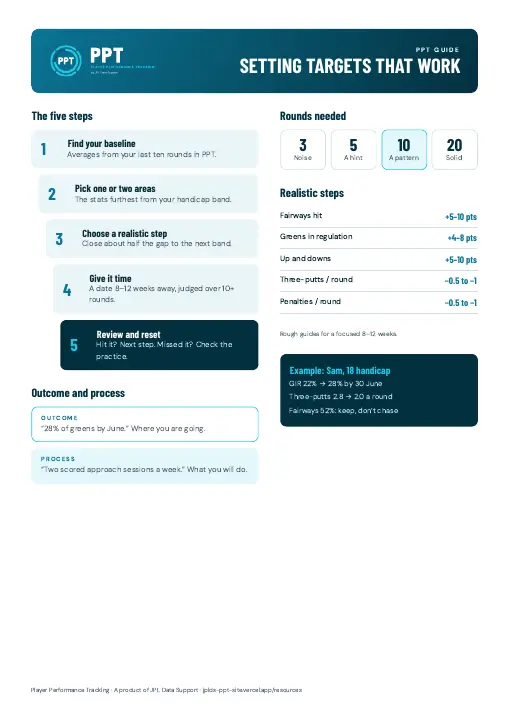
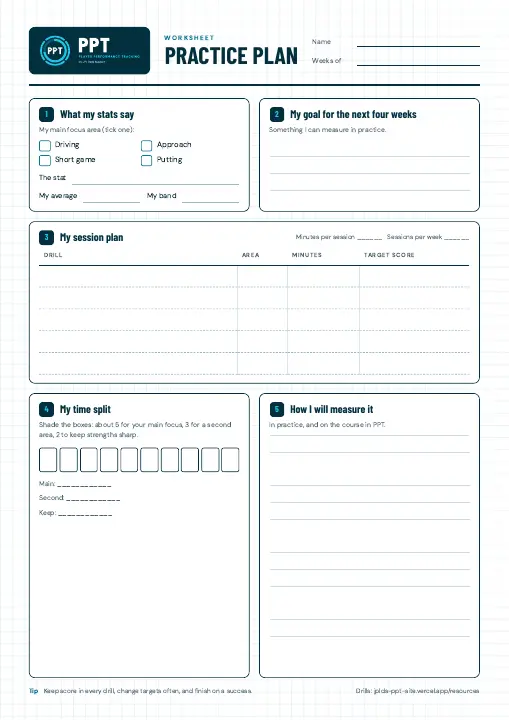
Once you know where the shots go, set a realistic target and build your practice around it.

Next steps: Setting targets that work and the Practice planning worksheet, free at jplds-ppt-site.vercel.app/resources

Keep going

Related resources

All resources →

A new version of this site is available.Refresh to see the latest updates.