Leaflet · For parents and carers

Supporting your junior golfer.

Your child’s club uses Player Performance Tracking to help young golfers see how they are improving. Here is what it is, how their data is looked after, and how you can help, without adding pressure.

Download PDFPDF A4 leaflet · 2 pages · 260 KB

In plain English

What is PPT?

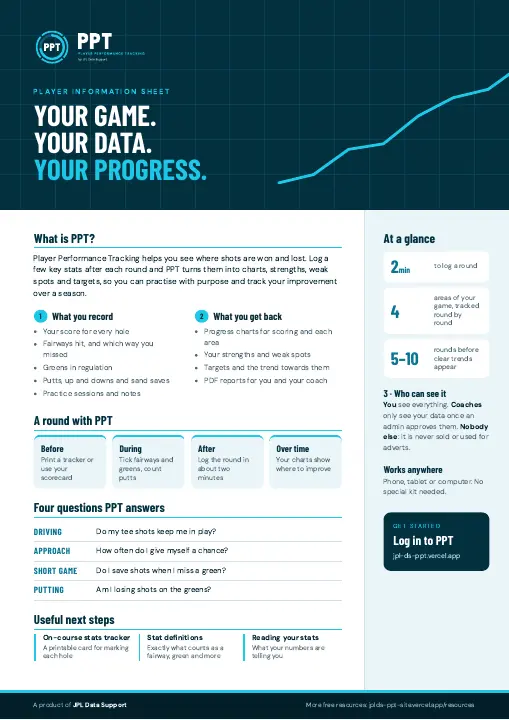
After a round, your child logs their score and a few simple numbers: how many fairways they hit, how many greens they reached and how many putts they took. PPT turns these into charts that show what is improving and what to practise next.

Their coach can use the same charts to plan lessons, so practice time goes where it helps most.

  • Two minutes

    to log a round, on a phone, tablet or computer.

  • Progress they can see

    Charts show improvement over weeks and months, not just one score.

  • Practice with a purpose

    Knowing what to work on makes practice shorter and more rewarding.

Your child’s data

Safe, private and only shared with approved coaches.

  • Only approved coachesA coach can only see your child’s rounds once a club or academy admin has approved them.
  • Never soldWe never sell your child’s data or use it for advertising.
  • Only what is neededPPT records golf: scores, stats, practice and notes. Nothing more.
  • We work with clubs and parentsYour club follows its own safeguarding policy, and you can ask it who has access at any time.

Read the full privacy policy, or ask your club’s junior organiser or welfare officer.

How you can help

Supportive, not pushy.

Young golfers improve fastest when golf stays fun and the pressure stays low. Small things from you make a big difference.

Things that help

  • Ask about their favourite shot before you ask about their score
  • Praise effort, decisions and attitude as much as results
  • Remind them to log the round while it is fresh, then leave it to them
  • Look at the charts together when they want to show you
  • Celebrate small improvements, like one fewer three-putt

Things to try to avoid

  • Going through every stat straight after a bad round
  • Comparing their numbers with other children’s
  • Logging rounds for them, or “tidying up” the numbers
  • Setting targets for them; let them choose with their coach
  • Reading too much into a single round

Conversation starters

Questions to ask after a round.

  • What was your best shot today?
  • Which hole did you enjoy most?
  • What did you do well when things went wrong?
  • Was there a shot you would play differently next time?
  • What do the numbers say you did better than last time?
  • What would you like to practise this week?

Looking at progress together

Read the trend, not the round.

One round can be a great day or a tough one. The value of PPT is the picture it builds over a season.

  1. Let them lead

    Ask them to show you their charts and explain what they see. It is their game and their data.

  2. Look over weeks, not days

    Trends start to mean something after five to ten rounds.

  3. Find one bright spot

    There is almost always an area that is getting better. Start there.

  4. Leave the coaching to the coach

    If something stands out, encourage them to raise it at their next lesson.

Questions parents ask

Good questions.

Does my child have to use PPT?

That is between you, your child and the club. Many juniors enjoy seeing their progress, but golf is golf with or without the numbers.

Can I see my child’s data?

The easiest way is to look at it with your child. If you have questions about access, your club’s junior organiser can help.

Who decides which coaches can see it?

An admin at your club or academy approves each coach request. Coaches cannot give themselves access.

What happens if my child leaves the club?

Speak to the club, who will update coach access. You can also contact us with any questions about data.

A guide for parents and carers

Supporting your junior golfer

Your child’s club uses Player Performance Tracking to help young golfers see how they are improving. Here is what it is, how their data is looked after, and how you can help, without adding pressure.

In plain English

What is PPT?

After a round, your child logs their score and a few simple numbers: fairways hit, greens reached and putts taken. PPT turns these into charts that show what is getting better and what to practise next.

Their coach can use the same charts to plan lessons, so practice time goes where it helps most.

  • 2 minto log a round, on a phone, tablet or computer
  • 5–10rounds before a trend starts to mean something
  • 4areas of their game: driving, approach, short game and putting

Your child’s data

Safe, private and only shared with approved coaches

  • Only approved coachesA coach sees your child’s rounds only once a club or academy admin approves them.
  • Never soldData is never sold or used for advertising.
  • Only what is neededScores, stats, practice and notes. Nothing more.
  • Clubs and parents togetherYour club follows its own safeguarding policy, and you can ask it who has access at any time.
Parents’ guide for juniors1 / 2

How you can help

Supportive, not pushy

Young golfers improve fastest when golf stays fun and the pressure stays low. Small things from you make a big difference.

Things that help

  • Ask about their favourite shot before their score
  • Praise effort and attitude, not just results
  • Remind them to log the round, then leave it to them
  • Celebrate small improvements, like one fewer three-putt

Things to try to avoid

  • Going through every stat after a bad round
  • Comparing them with other children
  • Logging or “tidying” rounds for them
  • Reading too much into a single round

Conversation starters

Questions to ask after a round

  • What was your best shot today?
  • Which hole did you enjoy most?
  • What did you do well when things went wrong?
  • Was there a shot you would play differently?
  • What do the numbers say you did better than last time?
  • What would you like to practise this week?

Progress together

Read the trend, not the round

  1. Let them lead. Ask them to show you their charts and explain what they see.
  2. Look over weeks, not days. Trends need five to ten rounds.
  3. Find one bright spot. Start with what is improving.
  4. Leave the coaching to the coach. Encourage them to raise questions at lessons.
Keep it fun. The juniors who improve most are usually the ones who enjoy it most.
Questions?Ask your club’s junior organiser or welfare officer, or contact us. jpl-ds@outlook.comjplds-ppt-site.vercel.app

A product of JPL Data Support

Keep going

Related resources

All resources →

A new version of this site is available.Refresh to see the latest updates.